

If you are considering a move from Australia to Dubai, a relocation guide and personal advice do different jobs.
A guide can explain the moving parts, define unfamiliar terms and help you organise your questions. Personal advice is needed when an appropriately qualified adviser must apply relevant rules to your circumstances or recommend what you should do within their professional scope.
The practical order is often: learn enough to frame the decision, sort the questions, then obtain qualified advice before acting on matters with significant tax, legal, immigration or commercial consequences.
At a glance
Key takeaways
- Use a guide to understand the moving parts, learn the language and organise the questions behind a relocation decision.
- Seek personal advice when rules must be applied to your facts or a qualified professional must recommend what you should do.
- Sort each question into general education, fact gathering or personal advice before deciding who should answer it.
- A guide and an adviser can work together, but neither should be presented as a substitute for the other.
What a relocation guide can help you do
A useful guide gives you a structured overview before you ask professionals to examine your circumstances. It can help you:
- identify the workstreams involved in leaving Australia and establishing yourself overseas;
- understand general concepts and options;
- prepare clearer questions;
- recognise which decisions may depend on one another; and
- identify where general information ends and personal application begins.
For example, immigration permission, tax residence and treaty residence are separate concepts that answer different questions. A visa does not, by itself, establish tax residence, and establishing foreign tax residence does not, by itself, end Australian tax residence.
A guide can teach you that distinction. It cannot use the distinction to determine your personal position.
Where personal advice becomes necessary
General information stops being enough when your question requires rules to be applied to your facts, a personal conclusion or a recommendation carrying significant consequences.
Australian tax residency illustrates the boundary. A residency assessment can involve physical presence, intention, behaviour, family and business ties, assets and living arrangements. No single listed factor decides the result by itself, and leaving Australia does not automatically resolve residency. ATO Taxation Ruling TR 2023/1: residency tests for individuals
That means two people considering the same destination may receive different conclusions. Their businesses, homes, families, travel patterns, conduct and intentions may differ.
An appropriately qualified adviser becomes important when you need someone, within their agreed professional scope, to:
- assess relevant rules against your circumstances;
- explain how competing facts or uncertainty affect the analysis;
- test a proposed structure or sequence; or
- recommend what to do before a consequential commitment.
Use the guide to find the decision forks
The Australian Exit Guide separates concepts such as immigration and tax residence, then brings personal facts, assets, structures and destination questions into the planning process.
That is a useful way to judge whether education has done its job: can you identify which missing answer could change your next decision?
Suppose a hypothetical reader begins with, “Should I keep my Australian home when I move?” Learning the general issues can turn that into more precise questions: how would the home be used, who would live there, what return arrangements are genuinely intended, and what financial consequences should an adviser assess before a sale or retention decision?
The guide has helped by exposing the forks. It has not selected the right branch for that person.
Try this short exercise with your most important unresolved question:
- Write the concept you now understand.
- List the facts or assumptions that remain unknown in your case.
- Identify what decision might change once those points are assessed.
- Take that decision to the appropriately qualified adviser who can address it.
If the immediate task is understanding terminology or preparing questions, education may be enough for that task. If you are about to rely on an answer to choose a structure, dispose of an asset or make another consequential commitment, resemblance to a guide example is not a personal conclusion.
You do not need to recreate every chapter before seeking advice. A precise question and an honest account of what you do not yet know are useful outputs of the learning stage.
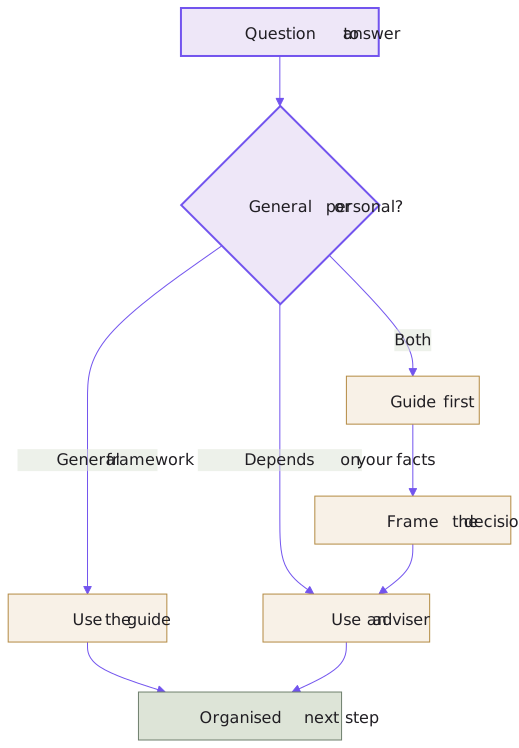
Decision aid: guide, adviser or both?
| Your immediate question | Sensible starting point | Why |
|---|---|---|
| “What workstreams are involved in leaving Australia and setting up in Dubai?” | Guide | You need orientation and a map of the issues. |
| “What do immigration permission and tax residence mean?” | Guide | This is a request for general definitions. |
| “Does my proposed move change my Australian tax residency?” | Appropriately qualified advice | The answer requires relevant rules to be applied to your circumstances. |
| “Should I change my company, asset or ownership arrangements?” | Relevant qualified advice | This asks for a personal recommendation with potentially significant consequences. |
| “What should I ask before choosing professional help?” | Guide, then clarify each professional’s scope | Education can improve your questions; each professional should confirm what they will address. |
| “I understand the concepts but need to decide what to do.” | Both | Use education to organise the issues and qualified advice for personal application. |
Sort your questions before the next step
Take the questions currently driving your move and place each under one of three headings:
Learn: I need a definition, an overview or a description of general options.
Apply: I need relevant rules or principles applied to my circumstances.
Decide: I need a personal recommendation before making a consequential commitment.
Questions under “Learn” can often begin with a guide. Questions under “Apply” or “Decide” generally need an appropriately qualified adviser whose agreed scope covers the issue. Some questions will move between headings: education may clarify the issue, but it does not replace the personal analysis needed before acting.
Project Get Out offers the Australian Exit Guide for entrepreneurs considering leaving Australia or restructuring. Australian Exit Guide General educational material remains distinct from advice applied to an individual’s circumstances.
If you need the foundations, explore the Australian Exit Guide. If you need a conclusion or recommendation about your move, discuss your circumstances with an appropriately qualified adviser whose agreed scope covers the question.
This article provides general educational information. It does not determine your tax residency or recommend a legal, tax, immigration or commercial course of action for your circumstances.
Important: This article is general information only and does not constitute legal, tax, financial, investment or immigration advice. Rules and programmes can change. Obtain advice from appropriately qualified professionals who understand your facts and the relevant jurisdictions before acting.