

The short answer: settle the decisions that could change your destination, timing or structure before making expensive commitments that are difficult to reverse.
Test your business model, family requirements, financial capacity and advice needs before ending a lease, selling important assets, booking non-refundable travel or signing a long overseas contract. You do not need every detail solved. You do need enough evidence to decide what can proceed, what should wait and who owns each unanswered question.
This article provides general information, not legal, tax, financial, immigration or personal advice. Your position depends on your circumstances and the rules applying at the relevant time.
At a glance
Key takeaways
- Resolve the dependencies that could change your destination, timing or structure before making costly commitments that are difficult to reverse.
- Work backwards from each proposed commitment and keep the next step focused on evidence when an essential answer is missing.
- Treat immigration permission, tax residency, business structure and family arrangements as connected but separate decisions.
- Seek advice before a buyer, price or completion timetable narrows the planning window for a major transaction.
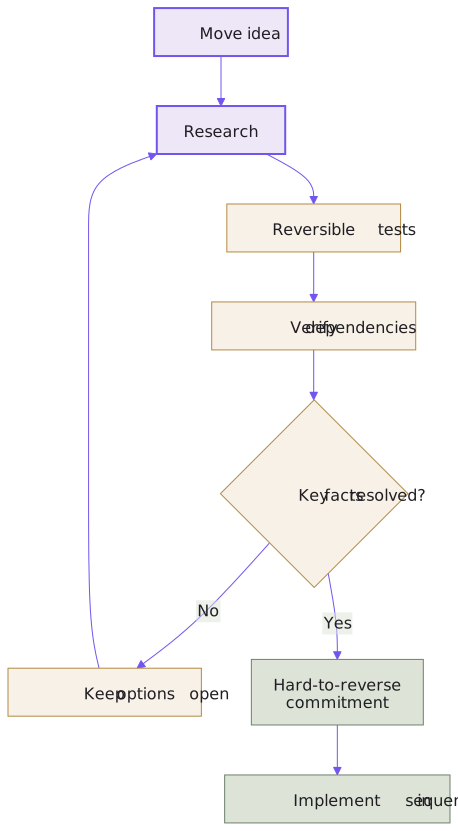
Work backwards from the commitment that would remove an option
The guide’s exit-planning approach places the review of facts, assets and structures before implementation and continues through establishing the new base and retaining evidence after arrival.
Use that approach to organise your own dependencies. Start with a commitment you are considering, then ask what must be understood before making it.
For example, a hypothetical owner is considering ending an Australian lease and accepting a non-refundable overseas booking. Work backwards from each commitment:
| Commitment under consideration | What needs to be established first? | What could you do while the answer is unresolved? |
|---|---|---|
| End existing accommodation | Household timing, the next living arrangement and advice on relevant implications | Gather terms and advice; keep the decision open |
| Accept a long overseas contract | A workable route, intended use, full terms and dependencies | Request a written offer and clarify conditions |
| Instruct a business setup | The activity, operating assumptions and questions requiring separate advice | Prepare facts and compare clearly defined scopes |
The point is not that these actions have one correct order for every person. It is that a completed administrative step should not force the answer to a more important unresolved question.
One example raised during our editorial review was an owner who sought structuring help less than a fortnight before a business sale was due to complete. By then there was a real price on the table, and any proposed change had to be considered in the context of that transaction and under severe time pressure. That does not mean useful advice becomes impossible once a sale is underway. It means the widest planning window often exists before a buyer, price and completion timetable are fixed.
The practical question is not only, “What can I change before completion?” Ask, “When could this transaction begin to limit my options?” Where possible, ask that months earlier.
Give each decision a review point: what information is needed, who will assess it and what would cause you to pause. If an essential answer is missing, make the next action information-gathering rather than a commitment made merely to preserve a preferred departure date.
Do not treat a visa as the answer to every residency question
Immigration permission, tax residence and treaty residence address different questions. A visa does not itself establish tax residence, and foreign tax residence does not itself end Australian tax residence. ATO: your tax residency Australian Treasury: income tax treaties
Before acting on a visa or company setup, ask an appropriately qualified adviser what facts matter to your Australian position. Give them concrete information: expected travel dates, available homes, family arrangements, business activities, assets and continuing Australian connections. Do not assume that obtaining one document resolves the other workstreams.
A reversible-versus-hard-to-reverse decision aid
Use this proposed worksheet to decide what can proceed and what should wait. Add a review date to every row so an old assumption does not quietly become the basis for a major commitment.
| Proposed action | Reversibility or exposure | Evidence to collect first | Dependency question | Review date |
|---|---|---|---|---|
| Research destinations and providers | Generally reversible | Written eligibility information, scope and exclusions | Does this destination suit the business and family? | ___ |
| Prepare a personal and business fact file | Generally reversible | Dates, assets, ownership, family and operating details | What is missing before advice can be useful? | ___ |
| Enquire about professional advice | The enquiry is reversible; commissioned work and fees may not be | Full facts, framed questions, fees and engagement terms | Is the adviser qualified for the question asked? | ___ |
| Pay a refundable reservation | Conditional | Written refund terms and expiry dates | What event makes the payment non-refundable? | ___ |
| Book non-refundable travel | Costly to reverse | Current travel advice and confirmed purpose | Can this wait or remain flexible? | ___ |
| End an Australian lease | Hard to reverse | Housing plan, timing and fallback option | What happens if the move is delayed? | ___ |
| Sell a significant asset | Hard to reverse | Personal tax and financial advice | Is the sale necessary before other decisions are settled? | ___ |
| Sign a long overseas lease or service contract | Hard to reverse | Eligibility, total commitment and exit terms | Which unresolved decision could make this unsuitable? | ___ |
These descriptions are prompts, not fixed classifications. Contract terms and personal circumstances can change the exposure.
Questions to resolve before a hard commitment
For every major action, ask:
- What decision does this action assume has already been made? A long lease might assume that immigration, business and family questions are settled when they are not.
- What evidence supports that assumption? Separate provider statements, current official information and advice based on your circumstances.
- What remains excluded? A company setup quote and an Australian exit plan answer different questions.
- Who owns the handoff? Record who advises, who implements, who supplies documents and who follows up.
- What is the cost of waiting? Delay has consequences, but urgency should be demonstrated rather than manufactured.
- What is the cost of being wrong? Compare the inconvenience of postponement with the cost and disruption of reversing the decision.
- What has an expiry date? Advice, eligibility information, quotes and travel conditions can change.
Reasons to delay the move
Delay may be the better decision when:
- Your destination choice still depends on an unresolved business or family requirement.
- You do not know how continuing Australian connections affect your position.
- Providers have not documented their scope, exclusions and handoffs.
- A commitment becomes non-refundable before an earlier dependency is confirmed.
- Your fallback plan depends on keeping an Australian home, role or asset that you are about to give up.
- Current conditions make the planned timing inappropriate.
For example, checked 19 September 2026, Australia advises reconsidering UAE travel. Australian Government Smartraveller: UAE advice Check the live advisory before acting. That does not decide whether Dubai is suitable in the longer term, but it should affect assumptions about immediate travel and implementation timing.
Make the next step smaller than the move
Your next step may be gathering facts, comparing written scopes or asking a qualified adviser a precise question, not booking a flight.
If you need a foundation for organising the issues, consider exploring the Australian Exit Guide. Australian Exit Guide If a decision turns on your own tax, legal, financial or immigration position, discuss it with an appropriately qualified adviser before committing.
A good plan does not manufacture certainty. It preserves your options until the decisions underneath the move are strong enough to support it.
Important: This article is general information only and does not constitute legal, tax, financial, investment or immigration advice. Rules and programmes can change. Obtain advice from appropriately qualified professionals who understand your facts and the relevant jurisdictions before acting.