

The honest answer is not “move” or “stay”. It is: choose the option that works across your business, family, lifestyle and finances, and delay the decision if important facts are still missing.
A move can look attractive on one dimension and fail on another. Your business may operate well overseas while the destination makes family life harder. Staying may cost more in one area but preserve valuable customers, support networks or flexibility. The useful comparison is not Australia versus an imagined overseas life. It is your current position versus a specific, researched move.
This article provides general information and a decision framework, not personal tax, legal, financial or migration advice. Rules and outcomes depend on your circumstances and should be checked with appropriately qualified advisers.
At a glance
Key takeaways
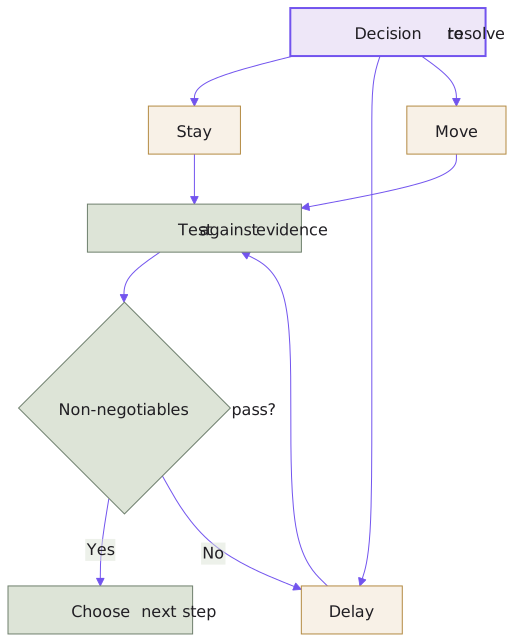
- Compare three real options: stay in Australia, delay while resolving specific uncertainties or move to a named destination.
- Assess your personal move, business operations and existing assets or structures as related but separate decisions.
- Test every option across business feasibility, family, lifestyle, full costs, reversibility and the quality of available evidence.
- Treat staying or delaying as valid outcomes when a non-negotiable fails or the case for moving depends on optimistic assumptions.
Start with three real options
Compare:
- Stay in Australia for now.
- Delay while resolving specific uncertainties.
- Move to a named destination under a workable plan.
“Overseas” is too vague to evaluate. Dubai may deserve a place on your shortlist, but it should not win by default. A useful move case needs to explain why one destination fits your actual business model, household and priorities better than staying or considering another location.
Delay is also a decision. It can be sensible when you need to test whether customers will accept an overseas operator, clarify a family constraint, investigate destination eligibility or obtain advice about the consequences of departure.
Decide what is moving: you, the business or both
Our Australian Exit Guide treats the owner’s relocation and the review of their companies, trusts and business operations as separate planning questions.
That changes the starting question. “Can I run this from Dubai?” is too broad if it combines your working location, the business’s operations and the way you hold assets into one decision.
Before choosing stay, delay or move, make three short lists:
| Part of the decision | What to write down | What would make you reconsider? |
|---|---|---|
| Your ordinary life | Where you would live, work and spend time with family | The proposed routine depends on arrangements you cannot sustain |
| The business | Which work, people, premises and decisions would remain in Australia or change location | The plan assumes the owner can leave without resolving a critical operating role |
| Assets and structures | What you own personally and through entities, and what needs separate advice | An unresolved asset or structure question could materially change the cost or timing |
These lists are a proposed decision aid, not a legal test. A move may be personally attractive while its business plan remains incomplete. Equally, a business opportunity overseas does not answer whether the household wants to build a life there.
If those answers point in different directions, delay the combined decision and investigate the particular conflict. You do not need to make every part of your life move merely to make the plan look consistent on paper.
The stay-versus-move decision aid
Score each option from 1 to 5, where 1 means “poor fit or materially unresolved” and 5 means “strong fit supported by evidence”. Do not total the columns immediately. First mark any issue that is a non-negotiable or requires professional advice.
| Decision area | Questions to answer | Stay | Delay | Named destination |
|---|---|---|---|---|
| Business feasibility | Can the business operate legally and practically from there? What happens to customers, staff, suppliers, banking and time zones? | |||
| Family | Does the option work for a partner, children, schooling, care responsibilities and access to support? | |||
| Lifestyle | Does ordinary weekly life suit you, not just a short visit? Consider climate, community, travel and distance from Australia. | |||
| Full financial picture | What are the one-off, recurring and contingency costs? How could revenue, pricing or operating costs change? | |||
| Australian departure | Which personal, business, asset and administrative matters need answers before action? | |||
| Destination establishment | What permissions, structures, housing and practical arrangements are required? | |||
| Reversibility | If the move does not work, what would returning or changing destination involve? | |||
| Evidence quality | Which answers are verified, which are assumptions and which need qualified advice? |
After scoring, use these rules:
- If a non-negotiable fails, do not let a high total hide it.
- If “delay” scores best, name the questions that must be resolved and set a review point.
- If a destination scores well only because of optimistic assumptions, replace those assumptions with evidence before committing.
- If staying scores best, treat that as a valid result rather than a failure to act.
The table is an editorial decision tool, not a calculator that can determine the right answer for you.
Do not use tax as a shortcut
Leaving Australia does not automatically resolve Australian tax residency. A residency assessment can consider physical presence, intention, behaviour, family and business ties, assets and living arrangements, and no single listed factor decides the matter by itself. ATO Taxation Ruling TR 2023/1: residency tests for individuals
That is why a headline tax rate cannot settle whether moving is worthwhile. Your comparison should account for the complete arrangement: what changes, what remains connected to Australia, the cost of establishing and maintaining the move, and how the business and household may be affected.
Avoid drawing a personal conclusion from someone else’s departure story. Collect your own facts and take them to an appropriately qualified adviser.
What to resolve before committing
Write one sentence under each heading:
- Reason: What specific problem or opportunity would moving address?
- Destination: Why is the named destination a better fit than Australia and the other realistic alternatives?
- Business: What must change operationally, contractually or structurally?
- Family: Who is affected, and which needs are non-negotiable?
- Money: What are the full one-off and recurring costs, using sourced figures?
- Advice: Which questions require tax, legal, migration or financial expertise?
- Ownership: Who advises, who implements and who follows up?
- Fallback: What is the plan if eligibility, business performance or family circumstances change?
If several answers are blank, you probably do not need more motivation. You need a fact-finding plan.
A practical next step
The Australian Exit Guide can help you understand the foundations and organise the questions involved in an overseas move. It is not a substitute for advice about your circumstances. Australian Exit Guide
Start by completing the decision aid for staying, delaying and one named destination. Then list every assumption you cannot verify yourself. Use that list to decide whether you need destination research, the Australian Exit Guide or a discussion with an appropriately qualified adviser.
Important: This article is general information only and does not constitute legal, tax, financial, investment or immigration advice. Rules and programmes can change. Obtain advice from appropriately qualified professionals who understand your facts and the relevant jurisdictions before acting.