

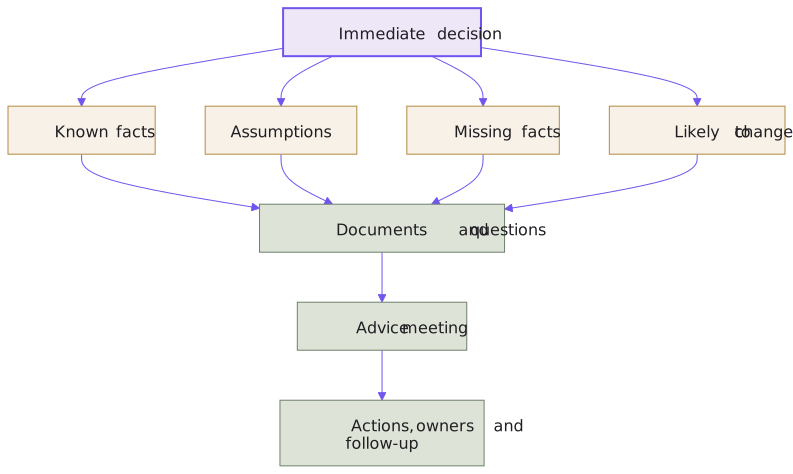
Your first relocation advice meeting will be more useful if you arrive with a short, accurate fact file. Separate what you know from what you assume, identify what is still missing and flag anything likely to change.
The aim is not to force a final answer in one call. It is to establish which questions can be answered from the available facts, what further information is needed and which assumptions need testing.
This is general educational information, not tax or legal advice.
At a glance
Key takeaways
- Begin with the immediate decision you need help making and a concise description of the proposed move.
- Separate known facts, assumptions and missing or changing information so the adviser can see what can and cannot be answered.
- Bring the operating reality of your business and household, not only a polished structure chart or intended plan.
- Confirm the useful documents, unresolved questions, responsible advisers and specific outputs before the meeting ends.
Start with the decision you need to make
Write down the immediate decisions behind the meeting. For example:
- Are we ready to choose Dubai, or are we still comparing it with staying in Australia or moving elsewhere?
- What needs to be understood before setting a departure date?
- Which Australian personal, business or asset questions require advice?
- What must be decided before taking any overseas establishment steps?
An Australia-to-Dubai move can involve connected Australian-departure and overseas-establishment workstreams. Naming the immediate decision helps the adviser identify which facts matter now and which can wait.
Describe the proposed move
Prepare a concise summary covering:
- who may move with you;
- your target timing and how firm it is;
- whether the move may be temporary, indefinite or remains undecided;
- where you expect to live and work;
- how often you currently expect to return to Australia;
- what must happen before you are willing to commit; and
- which other destinations, including staying in Australia, remain under consideration.
Do not turn a preference into a fact. “We want to operate from Dubai” states an intention. It does not establish that the move will proceed or determine its consequences.
Build the fact file in four columns
Use this proposed worksheet to organise the meeting. Add rows that reflect your circumstances.
| Topic | Known | Assumed | Missing or likely to change |
|---|---|---|---|
| Timing | The period you are considering | That business and family arrangements can fit that period | Confirmed dates, dependencies and flexibility |
| Household | Who may move | That everybody’s timing will align | Schooling, housing or family decisions |
| Australian home | Current ownership or lease facts | Whether you will keep, sell or lease it | Advice, valuations, finance or tenancy details |
| Travel | Available travel history | Expected future visits to Australia | A realistic proposed travel calendar |
| Business interests | Existing entities, ownership and formal roles | How operations may work after a move | Current structure chart and proposed changes |
| Work and customers | Where work, staff, contractors and customers are now | Where future work and decisions may occur | Contracts or operating arrangements still under discussion |
| UAE establishment | Intended activity | Which entity or setup may be suitable | Eligibility, scope and implementation requirements |
| Existing advice | Advice already received | That it remains applicable | Currency, scope and unresolved questions |
This worksheet is an editorial preparation tool, not a prescribed sequence, proven client process or substitute for personal advice.
Include the personal facts an adviser may need
Ask which facts are relevant rather than trying to decide their legal significance yourself. Depending on the issue, residency discussions may consider physical presence, intention, behaviour, family and business ties, assets and living arrangements. No single listed factor necessarily decides an Australian tax-residency outcome.
Do not dismiss a question because it sounds too ordinary. Your actual weekly routine, where your everyday belongings are kept and which home your family returns to may tell an adviser more than another polished relocation plan. None of those details is a test by itself. Together, they help make the factual picture accurate.
Your summary may need to cover:
- citizenship, visas and existing rights to live elsewhere;
- partner, children and other relevant family arrangements;
- current and proposed homes;
- expected travel between Australia, the UAE and other countries;
- Australian property, investments and significant assets;
- memberships, registrations and continuing commitments; and
- unsettled facts that could change the proposed move.
Leaving Australia does not, by itself, resolve Australian tax residency. A visa or certificate does not replace an assessment of the actual living, working and decision-making arrangements. ATO Taxation Ruling TR 2023/1: residency tests for individuals
Bring the operating reality as well as the structure chart
The guide’s entity discussion looks at actual high-level decision-making and business activity, while its evidence guidance stresses records that accurately reflect what happened.
A structure chart can identify entities and ownership. It will not, on its own, explain who approves important decisions or where work is performed. Bring a brief operating description beside it.
For each material activity, record:
| Activity | Current arrangement | Proposed arrangement | Evidence or unanswered question |
|---|---|---|---|
| Customer delivery | Who does the work and where | What you expect to change | Relevant agreements or an unresolved operating assumption |
| Major decisions | Who makes and approves them in practice | Any intended change in responsibility | Existing records; points needing explanation |
| People and premises | Where the team and facilities are now | What stays, moves or remains undecided | Current arrangements and proposed changes |
| Important assets and contracts | Who holds or uses them | Changes being considered | Ownership records and questions for advice |
Treat these as prompts for factual preparation, not instructions to transfer a function or restructure an entity.
Where a diagram, contract or intended plan differs from everyday practice, describe that difference openly. For example, a hypothetical owner might have a delegation document but still make the decisions it assigns to someone else. That is information for the adviser to assess, not a detail to tidy out of the summary.
If you cannot establish an answer, mark it unknown and identify the record or person that could clarify it. Accurate incomplete information is more useful than a complete-looking chart built on guesses.
Ask which documents would be useful
Confirm requirements and secure sharing methods before sending sensitive information. Depending on the meeting, useful documents may include:
- a current ownership or group structure chart;
- relevant recent personal and business tax documents;
- company, trust or partnership documents;
- property and lease summaries;
- employment, contractor or major customer agreements;
- visa or residency documents;
- travel history and a proposed travel calendar;
- written advice already received; and
- relevant scopes or quotes from implementation providers.
A long document bundle is not automatically a good one. Ask what is necessary for the questions being discussed, how it should be shared and who will have access.
Leave with specific outputs
Before the meeting ends, confirm:
- which questions can be answered from the current facts;
- which answers are preliminary or conditional;
- which assumptions need to be tested;
- what further facts or documents are required;
- which questions require a different appropriately qualified adviser; and
- what decision should be made next, if any.
General educational material and advice applied to an individual’s circumstances are different things. If you need the broader planning foundations before seeking personal advice, consider whether the Australian Exit Guide suits that need. Australian Exit Guide
A productive first meeting should replace a vague plan with an organised factual record, a clearer list of open questions and an honest view of what can and cannot be answered yet.
Important: This article is general information only and does not constitute legal, tax, financial, investment or immigration advice. Rules and programmes can change. Obtain advice from appropriately qualified professionals who understand your facts and the relevant jurisdictions before acting.